Tuesday, December 17, 2013

Allstate Drivewise. A huge failure in potential.

I've been meaning to get this one up for some time. For a short time I had signed up for Allstate's Drivewise program. Driving very few miles as compared to most other drivers and the fact that I don't drive like an idiot, I figured it was safe (nothing to lose). The problem is the data set that they've created their perfect driver rating system around are likely based on their payouts for accidents by type of braking, time of day, mileage, and excessive speed (80+ mph). Okay sounds good so far. I kind of figured this going in.

Overwhelmingly statistics apparently aren't on my side when they're being applied by Allstate.

When you dig into the Drivewise data after receiving your first set of "grades" you'll see 4 nice looking graphics in the interface. One for mileage, one for braking, one for time of day, one for speed in excess of 80mph.

Mileage

They go on to tell you that the mileage is a calculated projection of how many miles they think you'll drive based on your daily driving. If you're sticking to what they expect this shouldn't be a problem. I don't have a problem with mileage from the device because it coincides with the mileage from my odometer (which they already had on file). Spoiler, if you tell them you only drive 7,000 miles a year, and you really drive 50,000 the program will not give you a discount and the agent will have access to your actual mileage and will likely raise your premiums accordingly.

Braking

The braking section of the graphics show two things. "Hard Braking" and "Extreme Braking" are the two categories. According to Drivewise, hard braking is when you decelerate by 8mph in less than 1 second. If you're following a bus that makes frequent stops and you can not change lanes, depending on the bus driver's performance and lack of indication you will have a hard braking event (or two or four), someone walks out in front of you, a dog in the road, you get the idea. Extreme braking is when you decelerate by 10mph in less than 1 second. So if you come up to a short traffic light that has a 3 second yellow (these do exist) from 50mph and begin decelerating, you will likely have an extreme braking event. When you have 4 hard braking events and 1 extreme braking event over the course of 3 weeks this erodes any discount you would expect to receive from the program. I do mean ANY and ALL discounts.

Time of day

The time of day expectations for the program are really optimistic for Allstate. They have 4 categories. They've said that the "Lowest Risk" for accidents is on weekends between 5am and 11pm. The same time that most teens are out driving to work or shopping, etc. The "Low Risk" time is from 4am-12pm on weekdays (When teens are driving to school.). "Moderate Risk" is from 12pm to 11pm on Weekdays (When teens are on their way home from school or on their way to work at night). If you're out past 11pm you are driving at the "High Risk" time which is from 11pm-4am on weekdays and from 11pm-5am on weekends (Drunk people dodging, but luckily most teens are at home curiously enough).

Speed >=80

This one is pretty straight forward however they give a whole range of grading here where you basically stay below 80 or you don't. I don't understand this one at all because if you go above 80 you should be in the very high-risk category for drivers. Go get a racing license and take it out on the track. Now if you're in a state like Florida or Montana where you may encounter a 75mph speed limit, then it's understandable that this may need to be changed, but they're not trying to hide anything from you here.

My Suggestions

If Allstate really wanted their Drivewise program to be highly successful for them and to actually reward people who are definitely driving safely they would look at a different set of parameters.

Speed

Since the device already knows how fast the driver is going, it should be able to tell whether they are one of those people who can't maintain a constant speed. If the driver accelerates extremely rapidly (0-60 in 10 seconds) then they should have a record of drag racing on file. This could be road rage (extremely risky) or someone not paying attention to their lane ending... this might also obviously be drag racing, but the risks are the same. If the driver is running 65 and catches someone doing 45 and does not overtake or switch lanes, then they are not paying attention. Also if they decelerate by this much and maintain the speed it means that they either entered a construction zone, or they slowed down to the flow of traffic. If the device sees people accelerating and decelerating regularly it should know that the person is in a stop and start traffic jam. It already knows the time of day, so if the person is in rush hour stop and start traffic then it should know and place them in a higher risk category (for a low impact collision).

Location vs Speed

The device already has the ability to track vehicle location because it's transmitting on a cellular signal. If Google and most GPS systems can tell how long it will take to get to a destination, the device should be able to do this as well. This means if the driver is speeding and the device knows it, then they are risky and should not receive the discount. Something like 65 in-town in a school zone and they should put the driver into the high-risk category as well (for a high impact collision).

Crazy Driving

Add a couple of accelerometers to the device and now you can actually find the people who are weaving at risky times (drunks) and the people who are weaving on their daily commute (food-eating, texting, doing their make-up, you know... people who are exhibiting risky behavior). Also you can find the people who are insanely driving and weaving in and out of traffic with fast bursts of acceleration. Like the yellow semi truck that didn't like my Chicago Black Hawks tag.

Time of day

The Allstate Drivewise program needs to get a realistic idea of when people drive and when people don't drive in order to be successful. If I'm driving safely at a time of day when there is nobody on the road but me, then I shouldn't be in the high-risk category. If I'm driving when there are fewer people who are on the road like an afternoon after rush hour, I shouldn't be in a moderate risk category. If I'm driving when EVERYONE is off of work at the same time as they are on a Weekend, then I should be in a very high risk category (more people on the road=greater chance of an accident). If I'm driving when people are trying to get to work on time or they're trying to rush home after a bad day at work those are risky times as well.

I think if Allstate had actually taken the time to utilize the system instead of cutting corners, they could actually reward the people who are indeed safe drivers and profit from the people who aren't.

Suggested Upgrades

Add a couple of wireless cameras to the device. Let's put one in the front and in the back. Let's actually get some documentation on why someone is stopping abruptly. Don't outsource the research to a country overseas. Now you can have people in the US work from home and analyze the footage. It would help keep people off of the streets and off of the roads and it would also help with those fender benders that don't get reported. Not to mention auto theft, erratic driving and whether someone's towing a trailer at high speed. Yeah I'm talking about the people in the fast lane running 80mph towing the trailer that's rated for 45mph max.

Make the device aware on its surroundings. Add a hygrometer. Let's see if people are driving in the rain or driving when it's dry. Let's take some barometric pressure readings on the Drivewise device. Zero visibility thunderstorm, do you slow down? They should know. Let's add a thermometer. Driving on ice? The device should know. If you drive excellent on ice, then you should be rewarded. If you're more like a skating star doing twirls, whirls, and 720 degree spins, you should be penalized.

Make it driver aware, add something to the keychain so when a certain driver is in a closer proximity it knows who is driving the car. Sure you could swap keys, but this would definitely help if you had teens driving the car. That way they could tell who was a safe driver and who wasn't. Want the discount back, don't let junior drive your car.

All-in-all I'm 100% positive about making the roads a safer place.

What is the Allstate Drivewise really about?

The Allstate Drivewise device is not out to make the roads safer. In actuality if we look at the device from a completely different approach, it's a now a gimmick that invades the privacy of the driver. Allstate isn't interested in whether someone is a safe driver. They're interested in finding ways to make you pay high premiums. The higher risk they can make you in their book, the better off they are (monetarily). My agent seemed disappointed that I was healthy when applying for Life Insurance... gee, I wonder why that is? The same logic applies to car insurance. If you're a truly bad driver, the system will punish you, but if you're a good driver, then it's up to the insurance company to make up for the loss.

Realistically if we look at the stats from the US National Transportation Safety Board, most people aren't at risk of getting into a major accident on the road statistically. Only the select few. If we can keep those people off of the street, then sign me up. Until then, I'm keeping the Allstate Drivewise out of my vehicle because it makes me think about something when I'm behind the wheel that isn't related to my driving performance at all, and that's whether or not I'm going to be financially penalized about something out of my control. And when they do penalize me for something which is not a risk at all, I appear to them to be an "unsafe" driver, which helps them to justify charging more.

Get Wise Allstate.


A note on the edits
Originally I had mentioned that it might have been up to the device programmers, but that's not really fair. Once a product like this passes enough scrutiny panels in the production phase, good intentions of the designers are left in a pile for the sake of a little bit of savings. As long as the device gives a plausible illusion of savings, then the company will proceed.

Displaying measurements and SEO

Quote marks and other symbols vs. Abbreviations

In short, use an abbreviation that is regularly used and makes sense. (Eg. 1inch or 2mm)

How I've come to this conclusion
I had an epiphany today while working on SEO (Search Engine Optimization) for a site for one of my clients. We deal with measurements in American Standard, Imperial, US, NPS (nominal pipe size), and DN (diametre nominel) all the time. The measurements are all over the place depending on the age of the documents, the sizes and classifications are everywhere between really tiny .125in and massive 120in because of the range of products. It’s not easy to appease all of the people all of the time when they’re trying to find the right information because they all use the language that they were taught. Some people look for one measurement, while others (possibly in a metric-only shop) might look for something altogether different. The field and communicating in the field is challenging to say the least.

The main problem is when we’re displaying the content we use [inherited] copy that works for our American locations, but doesn’t translate well overseas. I mention this because some countries use an entirely different set of marks for quotation.  An example might be a range for the measurements 1"-3". My word processor (as I’m writing this) changed the typewriter double quote marks (double ditto marks) used for inches to “smart” [curly] quotes (right [side] double quotes). Quote marks and apostrophes are used in context in body copy and in the HTML code as well. So when you place a quote mark on the page, the search engine has to determine whether the quotation mark is in context as a quote, as a prime, as ditto marks, or closing (or opening) coded statement, then if it is used in context they have to determine whether you’re using it as a quote mark or as an indicator for a measurement, in this case inches.

 The search engine has to decipher the meaning of all apostrophes, double quotes, primes, and ditto marks on the coded page to decipher meaning. When someone writes 1' 2.75" they’re really saying one foot, two and three quarter inches. Since it’s not as easy to spell that all out and have people glance at a table in context, we need to write 1ft 2.75in (for consistency) so the search engines can tell what we’re talking about. Likewise, the range I mentioned before should be written as 1in-3in

To gain a different perspective, this document contains a variety of abbreviations and symbols for US including measurements (and they don't show quote marks and primes). You can see how using abbreviations inconsistently can lead to chaos (or in my case minute loss of page rank).


Now if we could only teach the search engines how to calculate ranges and relate to content for said ranges, as well as do calculations on the fly in context that would be awesome.

Friday, December 13, 2013

Why is Apple showing Nelson Mandela on their home page?

I was thinking about looking at Apple products again. Money in hand I went to their website to look for ideas for things to get because I'm a sucker like the rest of society... then I saw this on their homepage. Yes that's Nelson Mandela.

Screenshot of the Apple homepage 12/13/2013

Now to say Nelson Mandela was a great leader of men is an understatement. A super strong figure in the world who stood up for people other than himself. He effected great change in millions while he was alive. He changed the way people think about other people, and he brought into the light a huge issue in his country... an issue he helped to fix. You can read more about his awesomeness in the link.

Apple on the other hand has been shown time and time again their short comings in terms of how they quite oppositely create great divides in people. Apple perpetuates classes, not only in the markets they sell to, but in the workforces that make Apple products. This next year Apple will have to prove that they aren't using slave labor.

So back to my original question, why is Apple showing Nelson Mandela on their home page?

Well for that, the answer is simple. He's an excellent graphic hook. That's pretty much it. Oh, and by showing him on their homepage it makes them appear to be not as bad. No links to anything talking about how great of a man he was that might distract from the almighty marketing machine that IS APPLE however.  Additionally, research shows that a smiling handsome man who reminds everyone of their elders and all that is good in the world makes people happy. It makes us warm inside. It makes people a little more likely to let lose of their tight grip on the money needed to buy a phone or some other device.

Well this holiday season while the people at the Apple store work for their low wages, and the people in China and other countries where they make the components that go into the Apple devices will not be with their loved ones, remember that marketing is everywhere. Marketing changes who we are. It changes what we do. It changes our perceptions of everything. Marketing is the art of fooling the masses. And just because a company like Apple shows Nelson Mandela on their homepage doesn't mean they've changed their ways. It just means they've found another way to fool people into not seeing them for what they are... a company focused on their bottom line.

I work in marketing and I think what they've done here is wrong. Apple has gone too far. Share this if you agree.

Thursday, November 14, 2013

How to Protect your Google Accounts

I went into Google a few months back and viewed the plethora of information they have collected about me over time using information from domain names, social media accounts, browsers, email clients, and public record. It was alarming (but understandable). Use the internet for 20 years and you’ll have a backlog of info you’ve provided too. Two days ago I had to add yet another Google Analytics profile to my account. When I logged in, I saw the scrolling list of domains, and then it occurred to me that while I take precautions, many of my clients (who I also provide access to their sites via Google) might not take the same safety measures when it comes to protecting their Google accounts.


The method I use is called Two-Step verification. In short, to add another device (computers, phones, etc) I have an app [Google Authenticator] where I’ve already been authenticated. That app gives me a code that changes every 30-40 seconds, when I’m adding another system I simply open my phone, enter the code, then I’m verified. If I don’t have my phone on me, or someone else is trying to gain access to my accounts, then Google can prevent the access from that machine (if I’ve not yet used it).


Food for thought
One of my clients had to send out an email today along the lines of “Please ignore the last email to you from my email accounts, it was someone else.” That’s scary. While most other people might use Google Apps or G-mail, Google is striving more and more daily to make their accounts all seem fluid. So if you’re writing on Blogger, you’re using the same account you check your e-mail with. If you’re shopping with Google, then it’s the same account. If you’re posting messages on Google+, then its the same account… domain contacts, corporate email management, Google Analytics, and Webmasters access… not to mention anywhere you’ve logged in with your Google account as an OpenID. It’s sort of like making your Google account the holy grail of all things to hack. Google has the infrastructure to protect a lot of the attempts, but if you don’t take the time to enable the provided features (like two-step verification), you may find yourself the victim of more than identity theft.

Tuesday, November 5, 2013

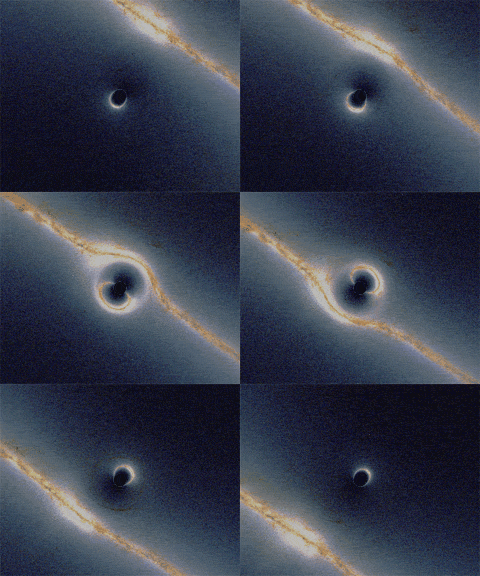
What if a black hole isn't a hole?

So I had this idea earlier today after watching a couple of videos on Quantum Physics and Quantum Mechanics yesterday. The idea that there could be something with so much gravity as hypothesized in a black hole seems a bit confusing to me since nothing would be able to escape its gravity. What if, however a black hole isn’t really a hole at all? What else could it be?


Then I started thinking about liquid hydrogen. We know from videos taken inside of orbiting space craft that liquid matter returns to a spherical state in space. For instance water in a vacuum will create little spheres. When light hits a sphere of water or any other clear liquid the light is refracted in a different way than a solid. When we look at a black hole, couldn’t we really be looking at the refracted dark space on the other side of a sphere of liquid hydrogen or helium, or even water?

Image from NASA


This would explain the gas based stars that appear to be emanating from the black holes. It would also explain why there appears to be a lot of gravity at the center of the black hole. An object large enough to be visible from this far away in space would definitely generate a lot of gravity. If the sphere isn’t so far away though, it wouldn’t have stars revolving around it at all.

It seems a bit odd to me though that with all of the spheres, from small sub atomic particles  all the way up to gas giant stars, that within the vacuum of the universe we would naturally have an object that isn’t a sphere at all. Just a thought.

Image from Black Holes on Wikipedia.org


Monday, September 30, 2013

Hughes Satellite Internet

And why it’s not as modern as its marketing suggests.


I recently found myself in a situation where I needed a faster internet connection in a remote location (other than an ADSL line) and had to look at options. The DSL line is 1.5mb and is being used as a comparison to the satellite. I weighed the various different satellite internet subscription options, and after reading hundreds if not thousands of reviews decided on HughesNet’s Gen4 PowerMax plan.

Speed

First off, the speed when it’s available is quite fast (1gb in 16 minutes) compared to ADSL 3mbps lines. During daily summer thunder storms it’s not completely off, but it does have quite a degraded signal. The internet satellite providers such as Hughes limit the speed of their connection. These limits come in a couple of forms, one of which is the physical limitations set on the unit itself. Having a 10/100 ethernet port, this would be the expected limit. The connection marketing suggests that the limits are set to 15mb/s however in our tests we’ve noticed around 10mb/s the unit shuts itself off and then synchronizes after about 30 seconds. If the connection doesn’t approach the system speed limits, it appears stable for a time.

Allowances

I’m not entirely sure about their reasoning, but Hughes sets a limit on the amount of bandwidth with what they call “allowances.” These allowances are really the downfall of the system. The timeframes for the allowances are between 2am and 10am for businesses with 20gb available during normal business hours and 25gb after hours. Any real business is not going to wait for the late night download period once they’ve exhausted their bandwidth for the day. For personal accounts 2am and 8am are the bonus hours and 8am to 2am regular hours with limits of 20gb each. The units do not provide consistent connections during “bonus hours.” This suggests that the system infrastructure needs to be upgraded to handle all of the requests for downloads overnight… that or Hughes knows this and is causing this limit on purpose. Either way it’s bad. In contrast, most high-speed internet connections such as DSL, Cable, and Fiber have much higher limits on the amount of suggested bandwidth.

A limit of 40gb per month seems as though someone could download quite a bit of data. The internet has changed however, so modern users who download multi-gig software updates and service packs and use something like IMAP to access their e-mail accounts on multiple devices (iPads, iPhones, computer e-mail, etc), will find themselves running out of bandwidth rather quickly. Most electronics do not allow downloads to happen overnight. While some plugins exist to schedule downloads overnight for PCs, in our tests we’ve noticed the system becomes unstable overnight and never completes a download (or upload) over 500mb after 2am. If IMAP is downloading the same e-mail on multiple devices at once there is a significant hit. Additionally sending an e-mail is also a multiple hit because the bandwidth limits are imposed for the SMTP transmission of the message to the mail server, the copying of the sent message to the IMAP folder, and the downloading of the sent message onto other devices on the connection. Web mail seems to be a good solution for this if you a strong web mail client is installed on the mail server.

Additionally during our first month we realized that poorly programmed web pages that constantly refresh data with meta refreshes and AJAX consume the bandwidth at an astronomical rate. Internet videos such as YouTube and Lydia.com seem to download reasonably well by downloading a cache and then playing. Streaming connections such as VoIP and Video conferencing dos not work well at all and additionally obliterate the monthly allowance for the connection. VoIP communications are clear in-bound but sound like "someone talking through a fan" on the other end.

DNS, caching, and other smoke and mirrors tricks

In the remote location I’ve resorted to running a DNS caching server over the ADSL line because the initial 30 second delay between typing in a domain name and waiting for the HughesNet Gen4 system to return an answer was painfully slow. Also this connection’s caching server has to run over the ADSL in my situation because any requests to the Root Servers from the system are blocked by the satellite’s firewall unless you use the service's default DNS servers. Additionally things like SSH and PPTP protocols also appear to be filtered and blocked. Any attempts at SMTP over port 25 are also blocked, but SMTP over SSH or TLS work. The Gen4 uses its own caching system to deliver pages seemingly quickly, however these pages aren’t always up-to-date, so they may need to be reloaded (requiring twice the bandwidth because they still penalize for the serving of the cached page).

IP address changing

Having to connect with the unit to any website or connection where a whitelisted IP address is required is excruciating. Over the course of one attempt at communication with a remote server I received no less than 4 different IP addresses in different ranges from my unit. These 4 ranges appear to be the usual addresses for the connection and have not changed over the course of a month. Also by whitelisting the reverse look-up domain name I was able to save myself some trouble, however this opened up the servers where the whitelists exist to worse security for the duration of the connection.

Tech Support

HughesNet’s extremely polite telephone tech support staff are not familiar with the units at all. The person we spoke with on the phone was not familiar with what a satellite dish was, much less the setup. They were only reading from a script. In our situation someone accidentally moved the dish, which prompted a Saturday afternoon call to their support staff (in India). Upon the initial interchange it was made clear to the satellite support staff that the dish had been moved and that we simply needed the angles and settings for realigning the dish. The support staff after 45 minutes of trying to determine why they couldn’t access the device remotely suggested that we enter a hidden interface on the unit ourselves (192.168.0.1 click the little gray “i” in the header) to retrieve the information from the unit. After seeing this information I was able to use the tools on the transmitter itself for realigning the dish (with physical socket wrenches)… which took another 45 minutes. Connecting to the transmitter using a cell phone over wifi made the process of dish alignment much simpler.

Final Notes


Overall, my experiences with the satellite have been somewhat different from most of the users who have a satellite alone since I am able to rely on the DSL in the event the satellite is down. Since I quickly exhausted my monthly allowance, had I not had a DSL line at my disposal I would have been dead in the water. I would suggest HughesNet Gen4 only as a last resort when all other options (cellular included) have been exhausted. For the brave, the speeds are immense and there is some level of anonymity since it’s not directly tied to a physical location.

Tuesday, September 24, 2013

Apple's new iOS7 - Location Services Required

Apple’s new iOS 7 is bundled with so many features it’s not even funny. One of the features, (and I’m not laughing about this one),  is rather than using the NTP servers to get Network Time based on preferred TimeZone, the geniuses at Apple decided to tie this to Location Services. If you don’t enable location services because you’re using multiple networks at once (like Satellite and DSL) or because you’re using a proxy server around the world, Apple is kind enough to set your location to the Pacific TimeZone. So now if you’re in Eastern Time and use your new iOS 7 alarm clock without noticing the change in TimeZone, you can get 3 more hours of much needed (but unexpected) sleep. 

To fix this feature, you can either enable Location Services (bad idea), or you can go into:
Settings > General > Date and Time

I’m a little bit of conspiracy theorist because of the things I notice in my job. One of the things I’m not in favor of is when a company, in this case Apple, tries to force me to use their data collection engine to get what once were standard features. In their new “operating system” iOS 7, when I enable Location Services I’m allowing Apple to track my every move and I’m sharing that information back with them. They can tell what my habits are, where I’m going, where I’ve been, and at some point this will all be tied to advertising and marketing (if it’s not already being used to pick locations for their new Apple stores).  Additionally, I don’t want Apple knowing that we’re running 3 WiFi networks and how many machines (and what types) are on our networks.

Location-Based Services

To provide location-based services on Apple products, Apple and our partners and licensees may collect, use, and share precise location data, including the real-time geographic location of your Apple computer or device. This location data is collected anonymously in a form that does not personally identify you and is used by Apple and our partners and licensees to provide and improve location-based products and services. For example, we may share geographic location with application providers when you opt in to their location services.
Some location-based services offered by Apple, such as the “Find My iPhone” feature, require your personal information for the feature to work.
I see a problem with this legal distinction because the data is not collected anonymously. They know who I am and what I do. I have a single device that contains everything from email accounts to passwords for services to all of the locations I've been at where I was around either a wireless network or a cellular signal. It's only shared with their servers anonymously (or so we're told)... unless you opt into cloud services. 

We may also disclose information about you if we determine that disclosure is reasonably necessary to enforce our terms and conditions or protect our operations or users. Additionally, in the event of a reorganization, merger, or sale we may transfer any and all personal information we collect to the relevant third party.
It's all getting foggy
Another trend with all of the newer services is the integration with the “Cloud.” Cloud is another way of saying “we’re storing your information on a server on the internet… somewhere.” If you want all of your contacts, photos, text messages, and e-mails stored on some server that is THE server people want to get into to collect all of the information in the world, then store everything on the cloud. After all there is safety in numbers, right? 


I myself am not in favor of cloud services because I like to control my own data, and I like to control who has access to it. If I enable cloud services and rely on them, now not only can I be charged to get to my own data, but at some point when I need this data if I’m not willing to pay I can lose all of my data. Also in the fine print, sometimes when I share data with companies they can share my data with their partners or use it to offer me better services. I know this because my clients frequently ask “how can we get more information or feedback from our customers?” What happens when someone unexpected gets this data? #ios7